
3 hr
Hiroshima Peace Cycling Tour with Local Guide
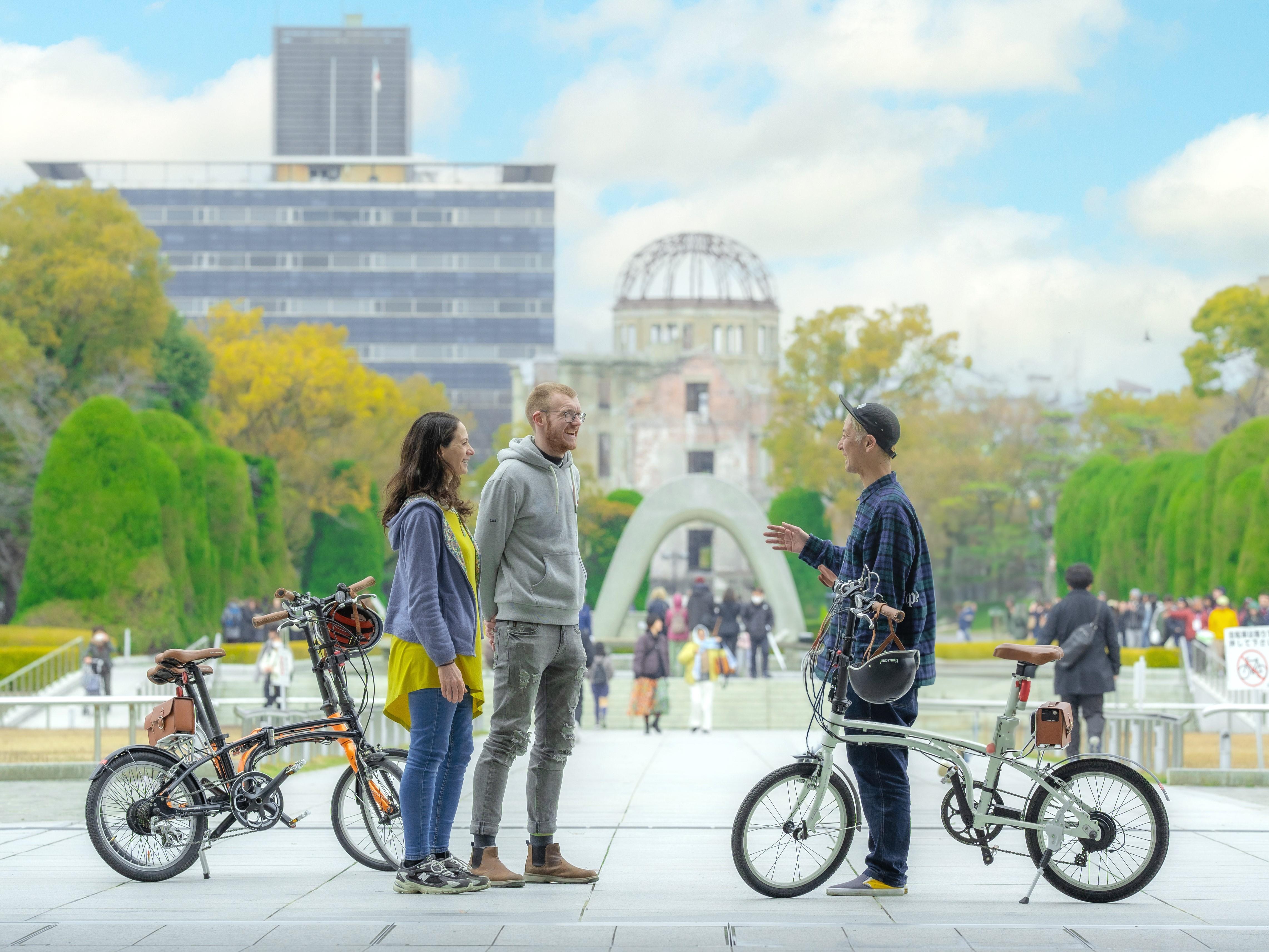
Pedal an electric bike through Hiroshima's atomic bomb heritage sites with a local guide.
Reserve
Hand-picked by our editors — only the best 5 experiences from 60 reviewed.
Verified partners for every tour, free cancellation where available, and instant confirmation on every booking.
3 hr
Pedal an electric bike through Hiroshima's atomic bomb heritage sites with a local guide.
Reserve
3 hr 30 min
Pedal a flat riverside route to Hiroshima's Peace Park, castle grounds and a serene Edo-era garden.
Reserve
3 hr 30 min
Explore Hiroshima's history and hidden nature by e-bike, from the Peace Park to a mountain temple.
ReservePrices from verified partners. Availability updates in real time at checkout. Free cancellation policies apply where shown.
The landmarks, rooms, and views travelers on this tour remember — all visible on a single visit.
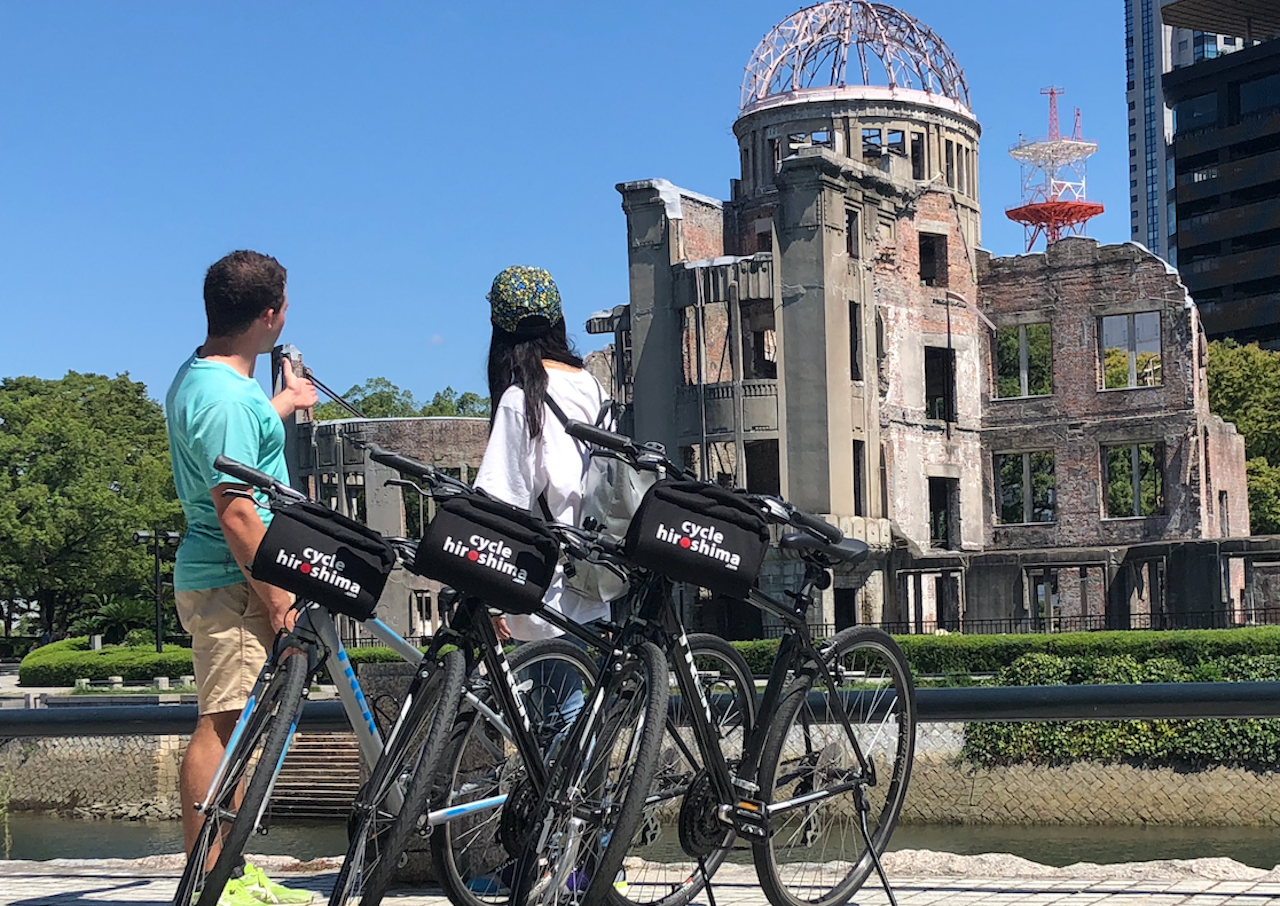
The skeletal remains of the former Industrial Promotion Hall serve as a powerful reminder of the 1945 bombing and stand as a UNESCO World Heritage site.
Designed by architect Tange Kenzo, this arched memorial holds a chest with the names of over 220,000 victims.
Dedicated to Sadako Sasaki and other children who died, this statue is surrounded by thousands of colorful paper cranes.
The sound of this bell, rung with a prayer for world peace, is designated as one of the 100 Soundscapes of Japan.
This flame has remained lit since 1964 and will continue to burn until nuclear weapons are abolished worldwide.
The Hiroshima peace bike tour offers superior mobility for seeing city landmarks, whereas the walking tour provides deeper focus on the Peace Memorial Park grounds. Both experiences complement each other, but most visitors who prioritize covering ground prefer the bike option.
| Feature | Top pick Bike Tour | Walking Tour |
|---|---|---|
Coverage Area |
Wide city radius | Peace Memorial Park only |
Pace |
Moderate and fluid | Slow and deliberate |
Physical Exertion |
Requires active cycling | Light walking only |
Interaction with City Landmarks |
Distance viewing while moving | Close observation of monuments |
Group Size |
Typically 4–8 people | Often 8–15 people |
Booking Convenience |
Requires hiroshima peace bike tour tickets | Hiroshima peace bike tour tours are distinct |
| See tickets → |
Verdict: Choose the bike tour for dynamic sightseeing across the city, or select the walking tour for a contemplative deep dive into history with a Hiroshima peace bike tour tour guide.
Choose your ticket, select your date, and reserve in under two minutes. Secure checkout handled by our verified partner.
Instant confirmation by email, with a mobile voucher you can save offline. No printing, no queuing at a collection desk.
Arrive at the entrance, show your voucher on your phone, and walk in. Most tickets include priority or skip-the-line access.
Practical details for your visit straight from our verified partners — hours, access, rules, and how to get there.
1-1 Nakajima-cho, Naka-ku, Hiroshima-shi
Check confirmation email for specific operator meeting spot.
Take the Hiroshima Electric Railway to Genbaku Dome-mae stop.
Casual, respectful attire is recommended for a hiroshima peace bike tour, as you will visit somber memorial sites. Sun protection such as hats and sunglasses is essential during summer months.
Most bike tours provide small storage or suggest using station lockers. Keep valuables secure during your hiroshima peace bike tour as you navigate through urban cycling routes.
Photography is permitted in public areas of the park, though visitors should remain sensitive when photographing memorial cenotaphs during a hiroshima peace bike tour. Respect signage regarding internal museum photography rules.
While Hiroshima is largely flat and cycle-friendly, inquire with your guide about specialized equipment for a hiroshima peace bike tour if you have mobility requirements. Electric-assist bicycles are frequently offered to aid with distance.
Family-friendly options often include child-sized tow carts or child seats for your hiroshima peace bike tour. Always confirm child age and weight limits with your chosen operator in advance.
Carry water to stay hydrated during your hiroshima peace bike tour. Hiroshima offers many local dining options near the park, such as okonomiyaki specialty restaurants.
1-1 Nakajima-cho, Naka-ku, Hiroshima-shi
Check confirmation email for specific operator meeting spot.
Get directionsBest time to go, insider tips, nearby landmarks, and the cancellation fine print — flip through to skim what matters to you.
How crowds, weather, and events shift across the year.
Mild temperatures ideal for cycling among cherry blossoms in March and April.
Small details that turn a good visit into a great one.
Book your hiroshima peace bike tour during the morning window to experience the park before peak heat.
Non-bookable sights within a short walk — free to visit, easy to pair.
A UNESCO World Heritage site and iconic structural remnant of the 1945 tragedy.
Flexible, no hidden fees.
Review your specific operator terms for hiroshima peace bike tour tickets. Cancellation windows vary by provider, though independent tour services often require 24–48 hours notice for full refunds.
Hand-picked options within walking distance — pick a district for vibe, or a specific hotel for convenience.
Wide range of hotels from boutique to budget near the peace district.
The Atomic Bomb Dome survived because the blast fell almost directly above it, driving force downward through walls that would have collapsed under any angled shock. Its skeletal cupola, designed by Czech architect Jan Letzel and completed in 1915 as the Hiroshima Prefectural Industrial Promotion Hall, stands today at the northern edge of Peace Memorial Park in Nakajima-cho. Before 1945, this ground was not a park. Nakajima was a dense commercial quarter of shops, theatres and temples on a sandbar between the Motoyasu and Ota rivers. Roughly 6,500 people lived and worked here. The district vanished in seconds. When Kenzō Tange won the 1949 design competition for the memorial precinct, he did not rebuild the neighbourhood; he laid an axis through it, aligning the Cenotaph, the Flame of Peace and the ruined Dome along a single sightline that any hiroshima peace bike tour will cross within its first ten minutes. That axis explains why the city reads so well from a saddle. Hiroshima sits on a delta of six river channels, almost entirely flat, with wide riverside promenades and generous cycle-friendly boulevards laid out during postwar reconstruction. Peace Boulevard, 100 metres across, was intended as a firebreak and became instead a green corridor. Guided cycling tours through the Hiroshima landmarks link the park to Hiroshima Castle, rebuilt in ferro-concrete in 1958 after its 1589 original was levelled, and onward to Mitaki Temple in the wooded hills to the northwest, where three waterfalls give the site its name. The park's collections are deliberately restrained. The Peace Memorial Museum holds a stopped wristwatch, a school uniform, the shadow of a person on stone steps. Outside stand the Children's Peace Monument and the paper cranes folded by Sadako Sasaki's successors, replaced in their thousands each year. The rebuilt Rest House, the sole Nakajima structure still standing, now houses a basement room preserved as it was. What matters today is continuity rather than spectacle. The Flame of Peace has burned since 1964 and is intended to be extinguished only when the last nuclear weapon is gone. Entry to the park itself is free, at 0 JPY, open daily 09:00–17:00, with tour services priced separately by independent operators. A hiroshima peace bike tour tour therefore functions less as sightseeing than as a slow reading of a rebuilt grid — the reason so many visitors choose bicycle-based Hiroshima peace park tours over any single indoor stop.
"Kenzō Tange did not rebuild the neighbourhood; he laid an axis through it."
A step-by-step walkthrough of the visit — what you'll see, how long each stage takes, and the details that matter.
You meet your guide near the park's edge, adjust the saddle, and roll out before the delta heat builds — the 09:00–11:00 window is the coolest and least crowded of the day. Within minutes you are alongside the Motoyasu River, looking up at the Dome's exposed girders from the water side, where the framework reads clearest. You dismount at the Cenotaph and stand where the arch frames the Flame and the ruin in one line. You wheel your bike past the Children's Peace Monument, its glass cases packed with folded cranes. On the small-group hiroshima peace bike tour you rejoin the group, cross a bridge, and pick up the wide green spine of Peace Boulevard, pedalling east then north. Hiroshima Castle comes next: you park below the moat, walk the gravel path past the surviving trees that regrew after 1945, and look up at the five reconstructed storeys. Options with e-bikes push further to Mitaki Temple, climbing gently into cedar shade where the waterfalls run. Longer itineraries swap the hills for a ferry, carrying you and the bicycles across the bay toward Miyajima. You finish back near Nakajima-cho with sweat on your shirt and a clear mental map of the six rivers. Park entry itself costs nothing — 0 JPY — so what you paid for was the route, the pacing, and the guide who knew which bridge to stop on.
Most operators for a hiroshima peace bike tour conduct services between 09:00–17:00.
The entrance fee to the park itself is 0 JPY, though guided tour services are priced separately.
Age requirements vary by operator; most offer child seats or carts for younger participants.
It is recommended to join a professional tour which provides reliable electric-assist bikes.
Yes, family-friendly operators provide equipment to ensure everyone can enjoy the hiroshima peace bike tour experience.
Operators usually have flexible rescheduling or cancellation policies for inclement weather.
The primary meeting point for many a hiroshima peace bike tour is the Peace Memorial Park Rest House at 1-1 Nakajima-cho.
Yes, you may photograph the landmarks during your hiroshima peace bike tour, provided you are respectful of the memorials.
Yes, you can easily visit the Atomic Bomb Dome and Shukkei-en Garden after completing your hiroshima peace bike tour.
Yes, booking your hiroshima peace bike tour in advance is highly recommended to secure your preferred slot.